
The Governor said the MPC had voted to maintain its accommodative stance, implying more rate cuts in the future if the need arises.

Broadly stagnant sales causes the first drop in business activity in over a year.

Thus far in FY21, BSE, NSE have rallied 70 per cent and 71 per cent, respectively.

Around 250 financial market players will participate in a closed door meeting with Narendra Modi on February 27.

The Index of Industrial Production (IIP) grew by 1.4 per cent in November as most components like manufacturing, electricity, mining, primary goods, and consumer durables witnessed a slowdown, according to data released by the National Statistical Office (NSO) on Wednesday. This is on the base of a decline of 1.7 per cent in November 2020 and before the new Covid variant started impacting economic activity. IIP growth was lower than the 4 per cent expansion recorded in the previous month but was better than a 1.6 per cent contraction seen in November 2020. Separately, rising prices of kitchen staples pushed retail inflation, or rate of price increase, to 5.59 per cent in December 2021, bringing it close to the upper band of Reserve Bank's comfort zone.

The new numbers clearly had very different implications.

RBI seen cutting repo rate 25 bps on Sept 29, says a poll

The speed at which he led the central bank in different areas -- ranging from internal reorganisation to inflation fighting, stabilising the currency, taking on rogue corporations, cleaning up bank balance sheets, and opening the sector -- makes one believe that Rajan knew he had only three years to do his job. A fascinating excerpt from Tamal Bandyopadhyay's MUST-READ Roller Coaster: An Affair with Banking.

Rajan had overturned the majority opinion of the members and chose to hold the rates at the last monetary policy review in October.

Tata Motors was the top gainer on better-than-expected June quarter revenues

It won't be an easy ride for the markets, reckon experts, considering the multiple state elections in 2018 and general elections next year.

RBI could opt for a 'deep cut' after winning inflation war, say experts.

According to bankers and economists, there is room for further rate cut by the RBI as retail and wholesale inflation rates have remained benign.

Analysts at foreign brokerage Bank of America Merrill Lynch said the RBI will cut rates by 0.25 per cent in December, and follow it up with a 0.15 per cent in February.
Growth impulses, while improving, remain fragile, and a rate hike will be disruptive to interest costs.

While selling started in April, it has intensified this month, with FPIs pulling out $1.1 billion and $2.5 billion from equities and debt market, respectively

With enough liquidity in the system, lending and deposit rates are likely to fall further
'Even if there is a third wave or a fourth wave, it is hard to see the economy will suffer like that (during the first wave).'

Weakness in the rupee against the US dollar also weighed on domestic stocks. The local unit fell 11 paise to 70.60 against the US dollar intra-day.

Barring stray references such as the 'dual control' of banks and shifting the goalposts during demonetisation, he is not in a fault-finding mode with the government, notes Tamal Bandyopadhyay.

The final and most significant reset in the relations between the government and the RBI is the manner in which the process of appointing the governor and deputy governors of the central bank has been changed.

'People know if inflation is not within the tolerance band, then action will be taken so they do not expect inflation to rise above that.'
It has already cut the rate three times this year to loosen credit and boost slowing growth in Asia's third-largest economy.

The minutes of the December MPC meet reveal members felt the current spike in the headline inflation rate was due to a temporary supply shock on the food front, expected to moderate by the second quarter of 2020-21.

RBI's liquidity tightening stance had stumped the Street as a result of which bond yields had risen.

The monsoon this year in India was likely to be 'below normal' at 95% of LPA: Skymet

India's first quarter GDP growth print was 7.9 per cent y-o-y, primarily led by urban consumption demand

The RBI cut rates for third time in 2015 due to favourable economic conditions.

Financials ended mixed despite the status-quo on key rates by the RBI. SBI, ICICI Bank and Axis Bank ended up 0.4-2.5% each.

India's GDP may turn positive at 1.3 per cent in the third quarter of 2020-21, having witnessed contraction in the previous two quarters due to the coronavirus pandemic, as the number of cases is falling and public spending has started rising, according to a report. The government will release the GDP numbers for the October-December quarter of the current fiscal on Friday. Projecting that the gross domestic product (GDP) may have returned to the black in the last quarter of the calendar year 2020, DBS Bank in the report said the full-year growth in real terms may be at a negative 6.8 per cent.

'We can go somewhere between 35 per cent and 40 per cent.'

The promise of a less suspicious government is surprising. What about the disconnect between the new business stance and earlier push to dictate the narrative in politics and public life, wonders T N Ninan.

Investors will maintain a cautious stance.

RBI recently cut repo by 0.25 percentage point, taking the rate to 7.25 per cent in three reductions since January.

TCS, Bajaj Auto, Adani Ports and Cipla were the top gainers on BSE Sensex while Coal India, GAIL, Dr Reddy's and Infosys lost the most on the index.
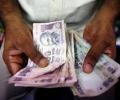
The rupee appreciated by 10 paise to close at a nearly six-week high of 60.29 against the US dollar in the previous session tracking a solid rally in local shares and continued dollar selling by exporters and some banks.

RBI has, since January, cut its policy rate four times.
As if wanting to be an antidote to the coronavirus pandemic, the Indian stock market adorned carnival robes in 2021 with a tsunami of liquidity unleashed by global central banks coupled with supportive domestic policies and the world's largest vaccination drive sparking off a world-beating rally on Dalal Street, despite bouts of uneasiness over fizzy valuations. While the wider economy shuttled between recovery and relapse, dictated by multiple mutations of the virus, equity market benchmarks appeared headed in just one direction -- skywards. The dizzying upward journey has added a whopping Rs 72 lakh crore during 2021 to investors' wealth, measured as the cumulative value of all listed shares in the country, taking it to nearly Rs 260 lakh crore.

Rajan announced a status-quo on interest rates.

The 30-share Sensex jumped 729 points to end at 28,076 and the 50-share Nifty soared 217 points to end at 8,494.
